 Back
BackThe SOC Capability Maturity Model (SOC-CMM Model) - Part 3
How Do You Measure SOC Readiness? The Maturity of Technology and Service Capabilities
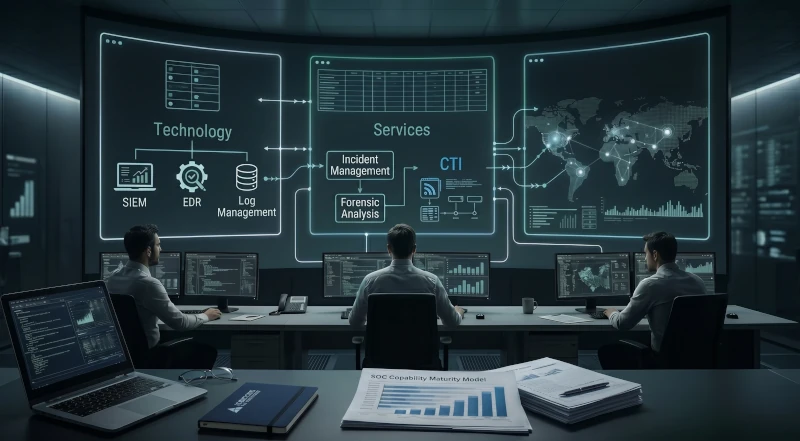
In the previous parts, we covered how the SOC-CMM model works, and the role of the Business, People, and Process domains in determining SOC maturity. But the model doesn’t stop at organizational and process factors — the SOC’s technological capabilities and service portfolio are just as decisive.
SOC-CMM treats the Technology and Services domains differently: for these, it measures not only maturity but also capability. This dual assessment matters because, for technology and service elements, it isn’t enough to ask whether a process or tool “exists” — you also need to evaluate how functionally complete it is, how well it works, and how effectively it supports the SOC’s goals.
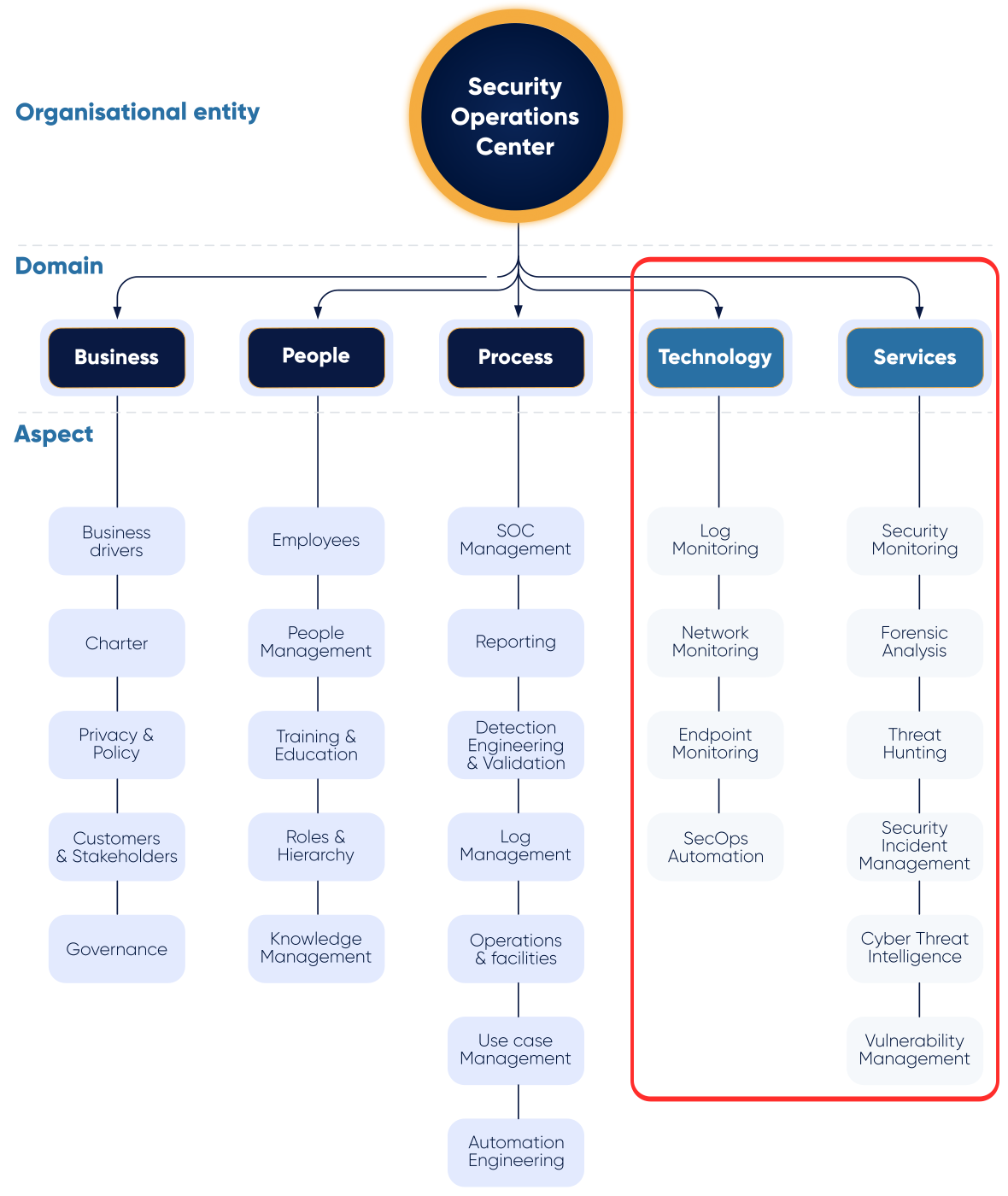
In this third part, we cover the remaining two SOC-CMM domains: Technology and Services. These domains form the SOC’s technical backbone and determine how effectively the SOC can detect, respond to, and proactively counter threats.
Technology — the Maturity of the SOC’s Technical Capabilitiess
The Technology domain examines which technological tools the SOC relies on for detection, analysis, and response, and how mature, well-configured, maintained, and integrated those tools are. Technological maturity isn’t just about whether a SIEM or EDR exists — it’s about how well those tools support SOC operations, how reliable they are, and how completely they cover the infrastructure.
What makes the Technology domain distinctive is that SOC-CMM assesses both maturity and capability here:
- Maturity shows how well-documented, consistent, and measurable the technology’s operation is.
- Capability shows how complete and advanced the technology is, and how well it supports the SOC’s objectives.
Aspects of the Technology domain:
- Log Monitoring: evaluates log source coverage, ingestion integrity, the quality of normalization and parsing, and the maintenance, configuration, and access control of the log collection system (including break-glass procedures).
- Network Monitoring: examines network traffic oversight, anomaly detection, recognition of lateral movement, and support for network forensic analysis.
- Endpoint Monitoring: assesses endpoint-level detection and response capabilities, including threat prevention, detection, isolation, and the quality of endpoint telemetry.
- SecOps Automation: assesses workflow automation, playbook-driven response, cross-tool orchestration, AI/ML-based automated decision support, and the maintenance and access control of automation systems.
Technology domain maturity determines how quickly, accurately, and reliably the SOC can detect threats — and how well it can keep pace with modern attack techniques.
Services — the Maturity and Completeness of the SOC’s Service Portfolio
The Services domain examines what services the SOC delivers, how complete and well-documented they are, and how fully they cover the company’s overall security needs. Service maturity determines not only the quality of operations, but also how well the SOC can respond to a changing threat landscape.
The Services domain also receives both maturity and capability ratings, since it’s particularly important that these services don’t just exist on paper — they need to actually function, be measurable, and create real value.
Aspects of the Services domain:
- Security Monitoring: evaluates the SOC’s detection capabilities, alert handling, monitoring coverage, OT monitoring support, and proactive anomaly detection.
- Security Incident Management: examines the maturity of incident-handling processes, response times, containment capabilities, and alignment with the NIST Incident Response framework.
- Forensic Analysis: assesses deeper analytical and forensic capabilities, including malware analysis, evidence collection, timeline reconstruction, and the maturity of forensic investigation tools.
- Cyber Threat Intelligence (CTI): evaluates the full threat intelligence lifecycle (planning, collection, processing, analysis, dissemination, feedback), along with CTI infrastructure operations and TI-driven detection support.
- Threat Hunting: examines the maturity of proactive threat hunting, including hypothesis-driven, TI-led, and ATT&CK-based hunting approaches, and support for automated threat hunting.
- Vulnerability Management: assesses the maturity of vulnerability management processes — from scanning through prioritization to remediation — including risk-based decision support.
Services domain maturity determines how well the SOC can not just react, but proactively counter threats — and how effectively it can support the company’s entire security lifecycle.
Case Example:
When Technology and Service Gaps Hold Back SOC Performance
A large enterprise’s SOC had a modern SIEM and EDR in place, yet critical events kept slipping through unnoticed. A SOC-CMM assessment of the Technology and Services domains revealed that:
- log collection coverage was incomplete — several critical systems weren’t sending data;
- network monitoring didn’t cover internal lateral movement;
- incident-handling processes weren’t aligned with the NIST IR framework;
- threat hunting was conducted only ad hoc, without a documented methodology;
- CTI data wasn’t incorporated into detection logic.
The technology was there — but capability and service maturity were lacking. As a result, the SOC couldn’t fulfill its intended role.
Summary
SOC maturity doesn’t rest on processes and people alone. It also depends on:
- what technologies are available,
- how complete and reliable they are,
- what services the SOC delivers, and
- how well those services cover the company’s security needs.
The maturity of the Technology and Services domains determines how quickly, accurately, and proactively the SOC can counter threats — and how much real value it can create for the business.
Frequently Asked Questions
Maturity measures how documented, consistent, and measurable a domain’s operation is. Capability measures how complete and technically advanced it is. Technology and Services are the only two domains SOC-CMM scores on both dimensions.
Log Monitoring, Network Monitoring, Endpoint Monitoring, and SecOps Automation.
Six: Security Monitoring, Security Incident Management, Forensic Analysis, Cyber Threat Intelligence, Threat Hunting, and Vulnerability Management.
Looking to Partner on SOC Delivery?
If your organization serves clients who need SOC capability — and you’d rather partner than build — Andrews offers flexible partnership models, from white-label SOCaaS to joint go-to-market. Let’s explore what fits your business.
blog
Related reading


Contact