
CISOs Without a "Firefighter's Helmet" — How Does a Managed SOC Help?
We show how, as an IT security leader, you can get out of daily firefighting and achieve enterprise-grade cybersecurity cost-effectively with a SOC service (managed SOC).
 Back
BackA million-dollar upfront investment, a talent shortage, and high payroll costs — or a predictable SOC service instead? Why should company leadership consider outsourcing IT security operations?

In late 2023, a severe LockBit ransomware attack crippled the UK's Royal Mail, bringing international parcel delivery to a complete halt. The attackers exfiltrated several gigabytes of internal data — including contracts, financial documents, and employee records — and published it after the company refused to pay the ransom. Service was disrupted for weeks, and recovery costs exceeded ten million pounds. The incident illustrates how a single successful attack can cripple critical infrastructure and inflict long-term reputational damage. — ComputerWeekly.com
Cybersecurity isn’t purely a technology or IT question — it’s a matter of business risk management. A successful attack can cause not only data loss but serious reputational harm, legal exposure, and direct financial loss. That’s precisely why building or outsourcing a Security Operations Center (SOC) is on the agenda at an increasing number of companies.
But what's the actual difference between an in-house SOC and SOC as a Service (SOCaaS), and why should company leadership lean toward outsourcing? That's what this article explores.
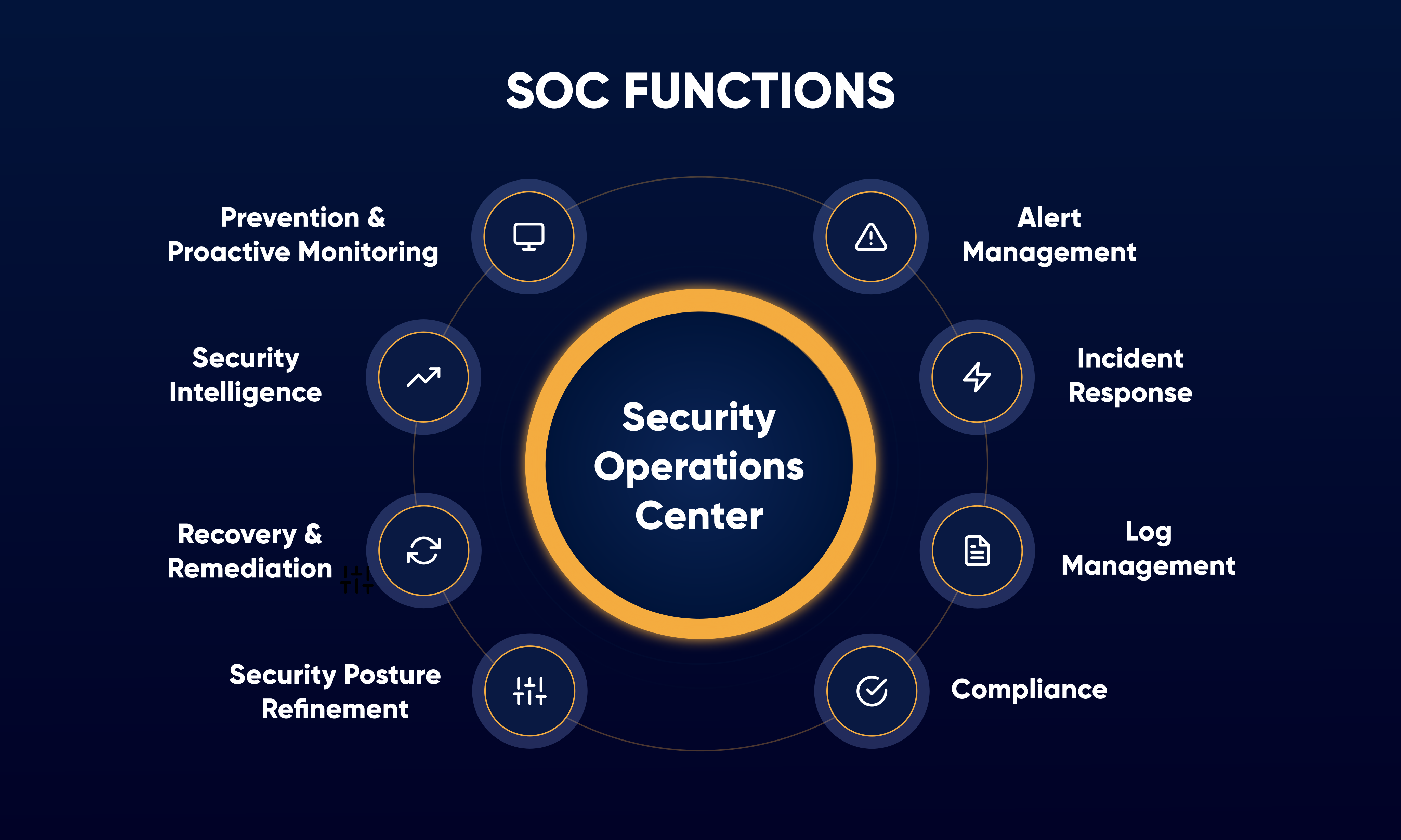
Now that we know what a SOC is, let’s look at how an organization can acquire this capability.
Building your own SOC looks appealing at first glance: full control, a dedicated team, in-house expertise. In practice, though, it comes with serious challenges:
Given all this, it’s easy to see why it’s mainly large organizations that build their own SOC — and even they, typically large banks and telecom companies, only commit to such a project after a thorough cost-benefit and risk analysis.
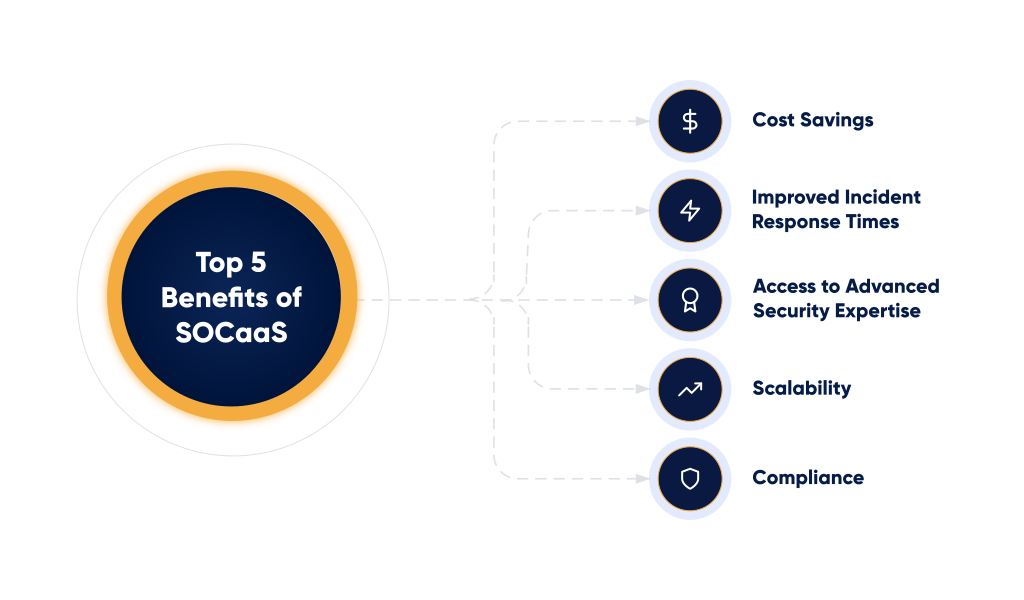
The essence of SOCaaS is that the security operations center is consumed as a service. There’s no need to build the entire infrastructure and team in-house — an experienced provider delivers all of it. From a management perspective, this brings several advantages:
The biggest advantage of SOCaaS is that it removes the burden of security monitoring from the company. SOCaaS takes over full 24/7 security monitoring and incident handling, freeing the internal IT team to focus on business development. Service quality is governed by a Service Level Agreement (SLA), which defines the provider’s obligations, responsibilities, and associated deadlines.
Example: If a bank secures the necessary security controls through SOCaaS, its internal IT team can focus on developing new digital services.
SOCaaS typically operates on a subscription model, so it can be adopted without a large initial investment. There’s no need to invest millions in technology or hire expensive experts — the provider takes care of all of that.
Example: A telecommunications company can gain access to the same level of protection for a monthly fee that a self-built SOC would cost many times more to deliver.
Because a SOC provider protects many companies’ systems in parallel with its team of highly qualified specialists and its extensive cybersecurity arsenal, its costs are spread across its client base — allowing it to keep pricing affordable.
Example: A price-sensitive mid-sized company can obtain a level of protection through SOCaaS that it couldn’t afford to fund on its own.
Not every IT system needs to be monitored — only the critical ones. SOCaaS offers selectable elements from a service catalog, so you don’t have to subscribe to every service, only what’s genuinely relevant to your company. This delivers further cost optimization.
Example: A retail chain only orders monitoring for its financial systems, without paying unnecessarily to protect every device.
SOC providers aim to price their services transparently, even for clients without deep technical expertise. Developing or operating systems in-house often comes with unexpected or hard-to-track costs. With SOCaaS, the subscription model rules that problem out from the start. There are no unplanned license fees or extra operating costs to account for. Because SOCaaS runs on a fixed monthly fee, the CFO can plan costs with precision.
The service can be flexibly expanded, so costs remain predictable even as needs grow. If the company’s operations expand, or a new regulatory requirement takes effect, SOCaaS can quickly be adjusted to match the required controls.
Example: If an e-commerce company enters a new market, expanding its SOCaaS coverage can be done in a matter of minutes.
SOC providers concentrate cybersecurity technology and expertise, which means they can support the protection of systems subject to virtually any legal or industry requirement. SOCaaS can simultaneously ensure MNB (National Bank of Hungary), NIS2, and DORA compliance, along with the security level required for business continuity.
Example: SOC providers’ standard operating procedures fully align with NIS2 requirements, making them a cost-effective solution for Hungarian companies subject to NIS2.
With an in-house SOC, “internal bias” is a common problem — a company’s own team often has a harder time spotting weaknesses and gaps in its own systems. SOCaaS, by contrast, provides independent, objective, evidence-based review and oversight. This is especially important for NIS2 and DORA compliance, where regulators expect well-documented, demonstrable controls.
Cybercriminals adopt the latest technologies quickly, so defenses have to evolve at a similar pace. It’s in a SOC provider’s core business interest to protect client systems with up-to-date knowledge and the newest technologies, since that’s their main line of business and revenue source. That’s why they continuously update their tools, apply AI/ML-based threat detection, and adapt to the latest attack trends.
Example: Through SOCaaS, an innovative financial services provider can gain immediate access to the latest AI-based threat detection solutions, without a separate investment of its own.
While SOCaaS offers many advantages, it’s important to recognize that it isn’t the ideal solution for every organization.
Hybrid models, which combine internal knowledge with SOCaaS capacity, can be a good alternative to these challenges. Under one approach, the company keeps its own L2/L3 experts, who handle specialized systems and business processes, while SOCaaS handles standard L1 tasks and hands off cases to internal staff when needed.
Under another model, the company runs a smaller, L1-level “mini SOC” of its own, and only calls on the provider’s experienced specialists for more complex L2/L3 tasks as needed.
Of course, every approach has its own trade-offs here too. Organizations for whom maintaining an in-house SOC isn’t economical or effective enough should seriously consider a hybrid or fully outsourced SOCaaS option.
Building your own SOC requires significant investment and ongoing resources, while SOCaaS offers a cost-effective, flexible, and scalable alternative. For business leaders, the benefits of SOCaaS are clear:
SOCaaS, then, isn’t just a technology service — it’s a partner that creates business value: it lightens the load, is cost-effective, predictable, and provides state-of-the-art protection.