CISOs Without a "Firefighter's Helmet" — How Does a Managed SOC Help?
We show how, as an IT security leader, you can get out of daily firefighting and achieve enterprise-grade cybersecurity cost-effectively with a SOC service (managed SOC).
Author: Andrews IT Engineering Published: 2026-07-22
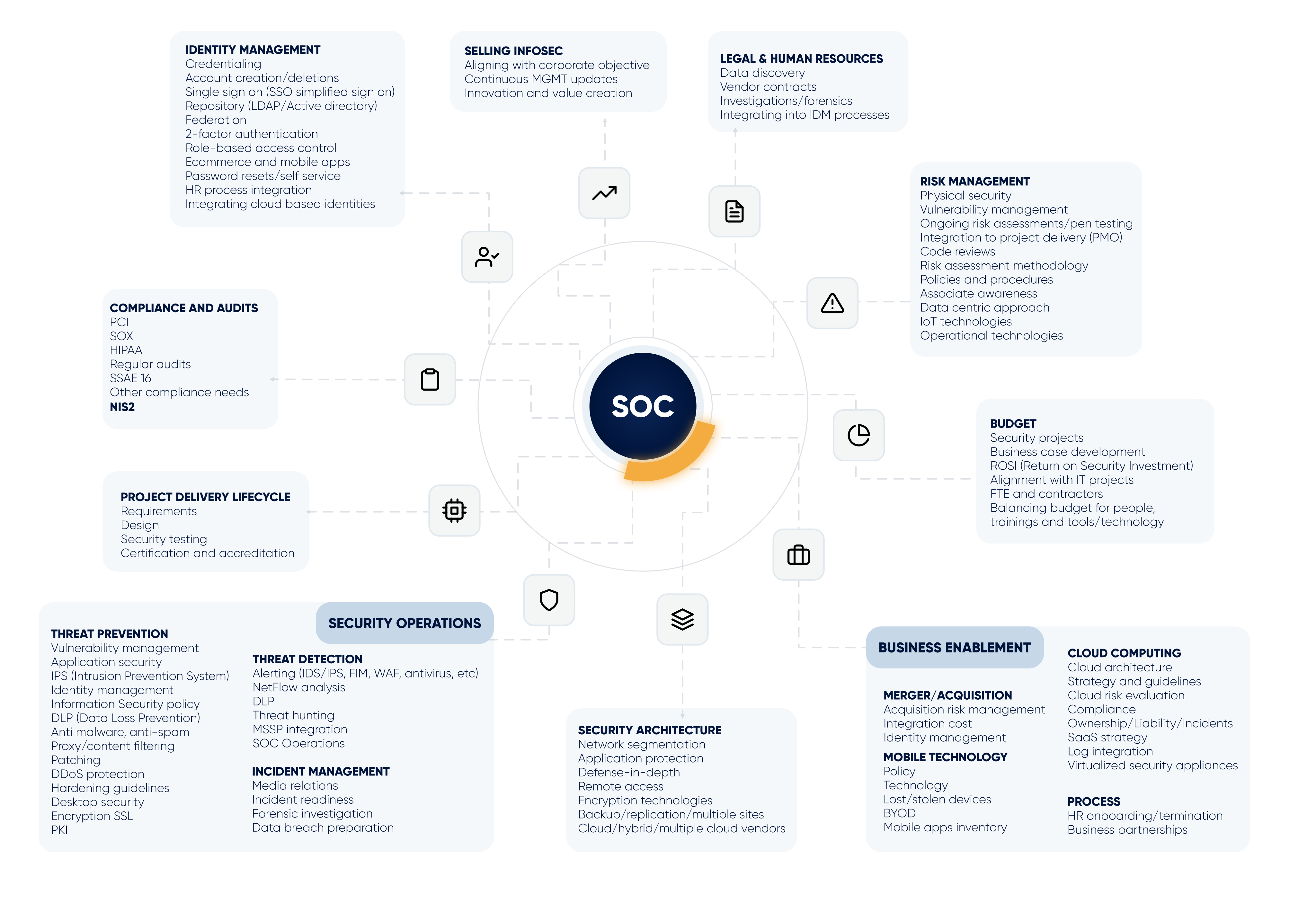
If you had to sum up the HR demands of a CISO’s IT security and compliance responsibilities in one sentence, it would be this: “This is not a one-man show!” The information security leader’s role has long gone beyond prevention, detection, and incident management. On top of the classic responsibilities — building the security architecture, risk management, identity management, and so on — CISOs now also carry business development tasks (e.g., the security challenges of M&A activity, defining mobile and cloud strategy, partnerships), plus involvement in various corporate projects. They have to align security with business objectives in order to sell the necessary investments to management, while also dealing with legal and HR matters.
And on top of all that come increasingly complex compliance requirements, such as NIS2, which now imposes strict security requirements even on companies with at least 50 employees or revenue exceeding €10 million operating in higher-risk sectors. The same goes for DORA, aimed at strengthening the resilience of digital services in the financial sector. These require constant attention — coordinating technical, documentation, and audit expectations — because compliance has to meet the required minimum standard at every single moment.
The CISO Mindmap - A complex approach to IT security and compliance through the SOC (Click to enlarge)
CISO Mindmap
Many Tasks, Many Tools, Many Specialists, a Lot of Money
As a result, many CISOs feel that even a small army wouldn’t be enough to cover everything in their job description. Even where a small security team exists, most experience it day to day not as building, but as putting out fires — all while the specter of a sweeping cybersecurity catastrophe looms overhead.
It’s not just the growing number of tasks that causes headaches, though — effectively covering them also requires mobilizing serious resources: a capable team of specialists, a significant technology arsenal, hardware, software, and various security services. In essence, the organization would need to build a Security Operations Center (SOC).
Once you tally up the tasks and the technical foundation needed to deliver them, it becomes clear: even a SOC that only covers the mandatory bare minimum is prohibitively expensive — and that’s before we’ve even discussed operating costs. Maintaining SOC capability is a question of economies of scale — building a cheap, small, in-house SOC generally isn’t feasible or worthwhile, because it can only operate efficiently above a certain size. The good news, though, is that SOC capability can also be purchased as a service. Security Operations Center as a Service (SOCaaS) — a SOC delivered as a service — can offer a comprehensive yet cost-effective solution (we covered the differences between an in-house SOC and SOCaaS in more detail in this article).
The CISO With and Without a SOC
"In August 2025, Jaguar Land Rover (JLR) fell victim to a severe cyberattack that forced the company to shut down IT systems at several UK plants and suspend production for weeks. The most likely root cause was a successful phishing attack. The attackers stole sensitive payroll data on thousands of current and former employees, including banking details, tax information, addresses, and benefits documents. The shutdown and data theft together caused damage in the hundreds of millions of pounds. Analysts believe this will have a lasting impact on the company's profitability in 2026." — Cyber Security News
What’s the “classic” practice at many companies without a security department prepared for every scenario?
Something suspicious happens in the company’s systems, and someone notices it — usually by accident, or because familiar services stop working — since there’s neither the time nor the resources for regular log analysis.
The CISO grabs the “firefighter’s helmet” and tries to resolve the problem or attack as fast as possible with whatever tools and resources happen to be on hand.
Then, because there’s no proper logging in place, no central log collection — meaning the company doesn’t actually understand its own systems in full depth, and typically doesn’t even know where an attack came from or what form it took — a days-long investigation follows, just to get a sense of the scale of the damage.
In a good scenario, the company learns from it and tries to prepare for similar incidents with technology and personnel — assuming there’s budget for it.
Under these circumstances, it’s nearly impossible for the company to meet NIS2’s required deadlines: reporting the incident to the National Cyber Defense Institute within 24 hours might just about be manageable, but assessing its severity, uncovering its cause, method, and scope within 72 hours is far more doubtful. Even the 30 days allowed for a detailed investigation can end up being tight.
Still, in a sense, it’s understandable that things play out this way at many companies. Business leaders tend to focus purely on revenue-generating processes, losing sight of the real risk that a major cybersecurity incident could bring down the entire company.
24/7 security monitoring at a SOC provider
24/7 Security Monitoring at a SOC Provider
By contrast, here’s how things generally play out at a SOC:
SOC experts continuously monitor logs and network traffic for anomalies indicating a cyberattack, such as suspicious traffic patterns.
They analyze risks — closely tracking potential cyber threats, prioritizing them, and taking or recommending preventive measures.
If an anomaly suggests a cyberattack, they raise the alarm immediately — and, if the service agreement covers it, intervene according to predefined processes and strict rules, taking the necessary countermeasures (incident response).
If authorized to do so, the SOC provider carries out the tasks required under NIS2/DORA: : reporting the attack to the client, assessing its severity, uncovering its cause, and making recommendations to strengthen defenses.
In other words, this doesn’t just raise the security bar (giving even an SME access to enterprise-grade cyber defense) — it also lifts a portion of the compliance burden off the CISO’s shoulders.
SOCaaS has an inherent advantage over in-house security. On the technology side, this is because it can maximize the utilization of its resources, allowing it to reach an optimal security level more cost-effectively. On the compliance side, it’s because its standard operating procedures fully align with NIS2 requirements.
And it’s in a SOCaaS provider’s core interest to do this well, since it’s their livelihood.
External Defense, Internal Peace of Mind
Not every SOC provider covers the full spectrum of the cybersecurity arsenal, but none of them sell a “pig in a poke.” Based on their service catalog — input requirements, applied procedures, expected outputs — you can build a precise picture of which areas they can cover and how effectively.
And if the CISO chooses well, they can hang up the firefighter’s helmet for good.
SOCaaS (managed SOC) takes the burden of operational oversight off their shoulders and provides experts for every area — as if the internal IT security function had suddenly gained the capability of four or five black-belt cybersecurity specialists — detecting, remediating (or supporting remediation), documenting, and reporting.
In other words, it reduces the company’s cyber risk and provides the peace of mind that lets management focus on the business.
Frequently Asked Questions
Day-to-day monitoring, alert triage, incident response, and much of the NIS2/DORA documentation and reporting burden — freeing the CISO to focus on security strategy rather than daily firefighting.
SOC capability only becomes cost-efficient above a certain scale. For most organizations, the infrastructure, licensing, and 24/7 shift staffing required make an in-house SOC prohibitively expensive relative to a subscription-based SOCaaS model.
Yes. A SOC provider’s continuous monitoring and predefined incident-response processes make it realistic to meet NIS2’s 24-hour notification and 72-hour assessment deadlines — something that’s very difficult to achieve without centralized logging and 24/7 coverage.
Looking to Partner on SOC Delivery?
If your organization serves clients who need SOC capability — and you’d rather partner than build — Andrews offers flexible partnership models, from white-label SOCaaS to joint go-to-market. Let’s explore what fits your business.
You probably didn't go into security engineering to spend all day sifting through alerts. SOCaaS takes over the monotonous, time-consuming tasks, so you can finally focus on the work you actually enjoy.
A million-dollar upfront investment, a talent shortage, and high payroll costs — or a predictable SOC service instead? Why should company leadership consider outsourcing IT security operations?
The effectiveness of a SOC service doesn't depend only on the provider's technology — it also depends on the client's own IT security readiness. What conditions do you need to meet for the service to work effectively?
Contact
Get in touch
We value your privacy
We use cookies to enhance your browsing experience, serve personalized ads or content and analyze our
traffic. By clicking "Accept All", you consent to our use of cookies. You can read more about our Cookie
Policy in our Privacy policy
Essential Cookies are strictly necessary cookies required to enable
the core functionality of the website such as storing your privacy preferences, secure user
login, account management and delivering the requested services.
Name
Expiration
Provider
Description
We currently do not use such cookies.
Functional Cookies allow us to offer you enhanced functionalities
when accessing the website and services. These cookies are generally used to remember login
credentials, location, preferred language, etc.
Name
Expiration
Provider
Description
We currently do not use such cookies.
Analysis cookies collect interaction metrics such as the number of
visitors, bounce rate, time spent on the website, etc. which helps us understand how our
websites are being used to enhance your experience or to measure the website audience
statistics.
Name
Expiration
Provider
Description
_ga
2 years
GOOGLE INC.
This is the primary cookie used by Google Analytics to distinguish unique users. It
stores a unique user ID and tracks users across sessions and visits.
_ga_GS0E15ZM81
2 years
GOOGLE INC.
Used to persist session state for each unique user.
Advertising companies use these cookies to serve ads that are
relevant to your interests. The information collected by these cookies is used to create user
profiles to help measure the effectiveness of the advertising campaign.
Name
Expiration
Provider
Description
We currently do not use such cookies.
Cookies are small text files that are placed on your computer by websites that you visit. Websites
use cookies to help users navigate efficiently and perform certain functions. Cookies that are
required for the website to operate properly are allowed to be set without your permission. All
other cookies need to be approved before they can be set in the browser.
You can change your consent to cookie usage at any time on our Privacy Policy page. We also use
cookies to collect data for the purpose of personalizing and measuring the effectiveness of our
advertising. For more details, visit the Google Privacy Policy.
 Back
Back